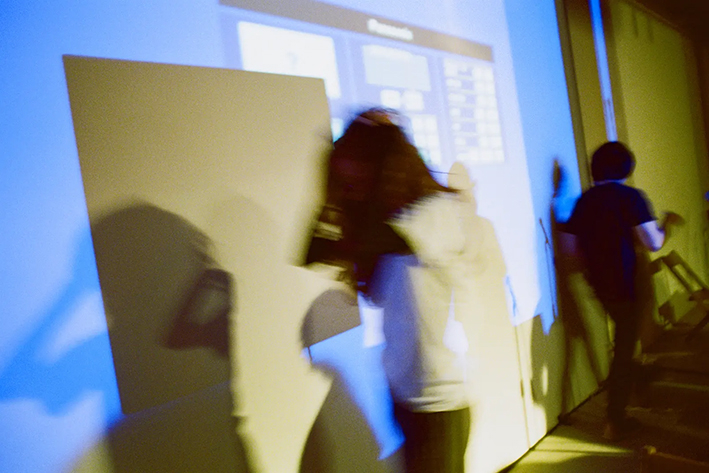
Stephanie LaCava performing with Demsyl, New York © 2025 Ellie Hoffmann.
Stephanie LaCava, in conversation with Ellie Hoffmann
New York, 2026
A couple of months ago, I met Stephanie LaCava through our mutual friend Manon Lutanie. I spent some time with her—first at her book signing (Nymph, Verso Books, 2025) at Mast in the East Village. Then, we met up again at a gig of the band she formed on the occasion of the book release, Demsyl, on October 20th, 2025. The concert took place in the basement, of Artists Space, where Stephanie was performing with Mark Iosifescu, Jack Callahan, and Laszlo Horath. (Max Lawton had also wrote the songs.) I took a few pictures that night, then we met to talk about Demsyl.
-
EH: I was telling Manon about going downstairs at the concert venue. It was funny because there were all these different men doing things with wires. I'd never seen anything like that. And I talked with this guy, Bradley Eros, who was projecting slides.
SL: Oh, yes. A lot of those guys have been doing it for years and years. Bradley's a legend.
EH: You know, he lives on my street.
SL: Really?
EH: Yeah.
SL: That's so fun. New York is epic for these kinds of things.
EH: My mom calls these kind of moments a ‘New York moment’.
SL: Where's your mom from?
EH: She's from LA and New York— back and forth. She's a painter. Her dad was a painter, so she is very much was trying to find her own voice.
SL: And what about your dad?
EH: My dad is German. I think he moved to America for the American dream. But I don't know what the American dream is now.
SL: Nobody does.
EH: It’s hard to figure out what to focus on. You have always written, but when did you start with sound and music?
SL: It's quite funny because I'm extremely sensitive to sound and loud noises. For example, I don't like going to restaurants where there's music. When I was young, I would avoid concerts. On the other hand, I like really visceral emotional outbursts of energy. It's just has to be the right thing at the right time. And maybe when I'm prepared for it.
EH: You know what you can handle and what you can’t.
SL: I'm trying to understand this a lot more lately. And then this comes up in the writing and the music. My initial reactions, what they mean. Maybe I haven't for a long time seen them to mean the right thing, or understood what is the right thing or what does that impulse even mean. In terms of receiving the signal. Also, you know, I am learning. More specifically with this music, I I didn't know all about the pedals or the chords. I loved that.
EH: The technical side of things.
SL: The distortion and how it affects the image and sound. I've always had a particular fascination with cinema soundtracks. So that's also something I've always sort of thought about. The music is paired with the image and it changes the reception. Like a song that you've always known put in a different context.
EH: Can we talk more about the visuals behind Demsyl? The ones that were projected onto the wall in the basement.
SL: I recorded them. There's a church way uptown with a subterranean basketball court. I just love this space. So, I made some short videos on my phone which we used as visuals.
EH: I thought it was really interesting the way that you filmed it. It felt like the point of view of someone, like a kid discovering a room.
SL: We used these same short movies with the recording of some of the songs as a “film” at the ICA, because we weren’t able to perform there.
EH: Do you feel like you become someone else when you’re on stage?
SL: It’s funny you ask that, because I guess some of my written work is about people who have personas. I'm also really interested in how, say, athletes always talk about having sort of an alter ego even though they may not readily admit it. I think a lot of people do and don't talk about it. That's interesting to me. Not that I go into one, but this idea that enabled access to a kind of athleticism of persona. You clock out on fear or something like that. I mean, it's how every superhero works. It’s an interesting thing in storytelling.
EH: Yeah. And I feel like that sort of character to tap into doesn't just happen on stage. It happens throughout our days.
SL: Yes, people do it every single day. Kids definitely do it. You just don't tell anyone as you get older, but you probably still do it.
EH: In Nymph, I noticed that metal is a big part of the story, not just the musical style, but the mythology. I almost felt it was like a character in the book.
SL: That's also why I wanted to try out the metal ideas—to try and write some songs and perform in that way. To link back to the character Bathory in the book. Her name refers to the Scandinavian black metal band. It’s lead singer's dad was a music executive, which I find funny. That's very different than certain ideas behind punk music.
EH: Were you listening to anything specific when writing the book?
SL: I can't listen to music when I write. Certainly nothing with lyrics, which is funny because then I started writing lyrics. If I listen to anything, it’s classical music. I either want to be fully zoned out or dancing. I don't like music as ambience. I like music if I’m focusing on it—listening or dancing to it.
EH: After the New York concert, you performed in Louisville, with other musicians. How was the concert?
SL: It was really intense because we only were able to get together to practice the night before. I had written some lyrics or pulled from stories I’d written.. There was also some Apollinaire and Louvin Brothers. The guys [Chris Wunderlich, Kris Abplanalp, Britt Walford, and Barrett Avner] had amazingly gotten together and also written songs for the occasion. And then we just did it.
We were performing in this cave space. It was really special. I was the outsider, they were letting me in and I felt lucky.
EH: It was underground.
SL: Yeah.
EH: And so fun.
SL: So, obviously I'm not a metal band singer. But it was a thing we tried.
EH: And how much longer will Demsyl perform for?
SL: I think it's done for now. There's been talk of maybe doing other things, and I think it could become something else. But it's probably not going to happen again in that way.
EH: It's exciting for it to be kind of there and then disappear.
SL: Yes. We're never going to be that group of people again. And everyone has other projects. Take New York as example. Lazlo is an artist and was practicing for another performance (as part of Performa) at the same time as our rehearsals. Mark was also working on a big review of the new Pynchon book while we practiced, which was so generous. He also has a novel in the works and many other musical projects. Mark was really patient with me and I learned a lot of things from him. Jack produces and plays incredible music. And Max, of course, is an incredible translator and has a novel coming out this year.
EH: Thank you for talking to me today.
SL: Of course.
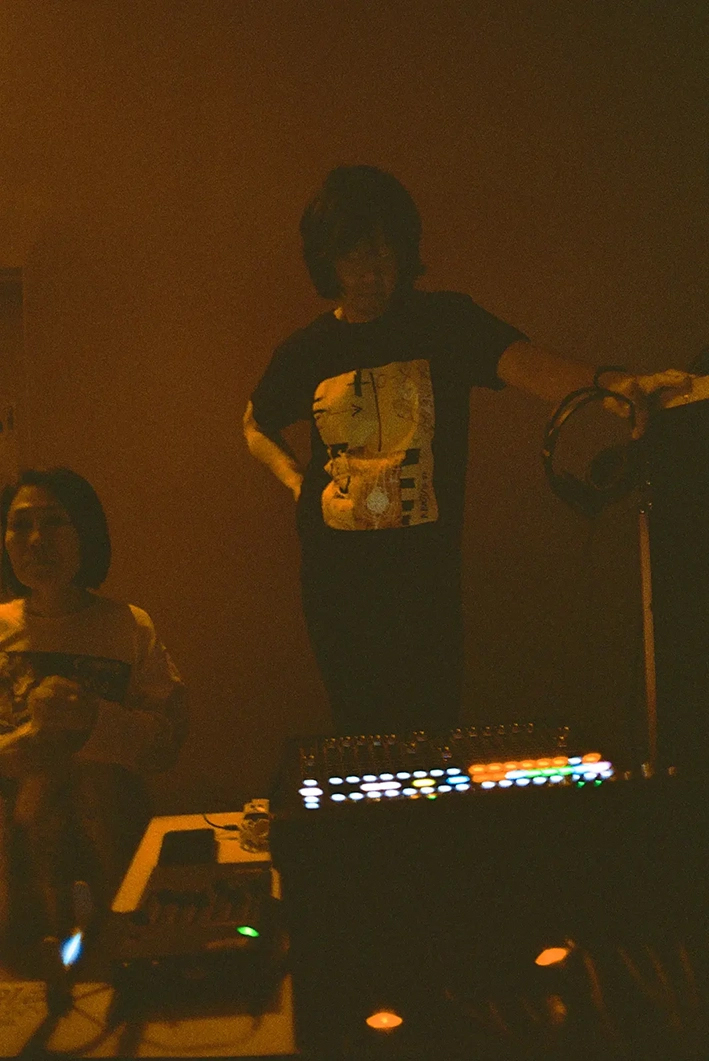
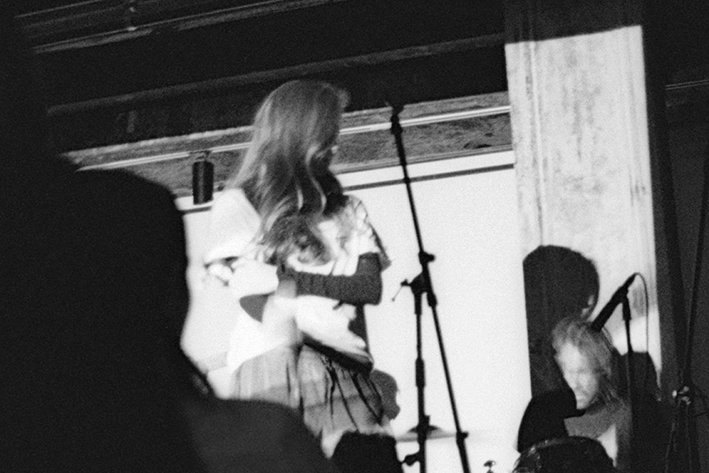
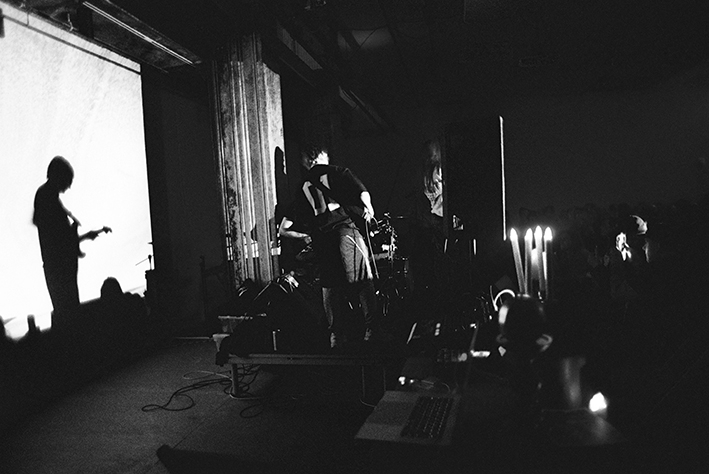
Stephanie LaCava performing with Demsyl, New York © 2025 Ellie Hoffmann.
-
Stephanie LaCava is a New York City-based writer. She is the author of three novels, 2020’s The Superrationals (Semiotext(e)), 2022’s I Fear My Pain Interests You (Verso), and 2025's Nymph (Verso). She also runs a publishing project called Small Press.
Ellie Hoffmann, born in 2003 and raised in Los Angeles is a photographer studying in London.